
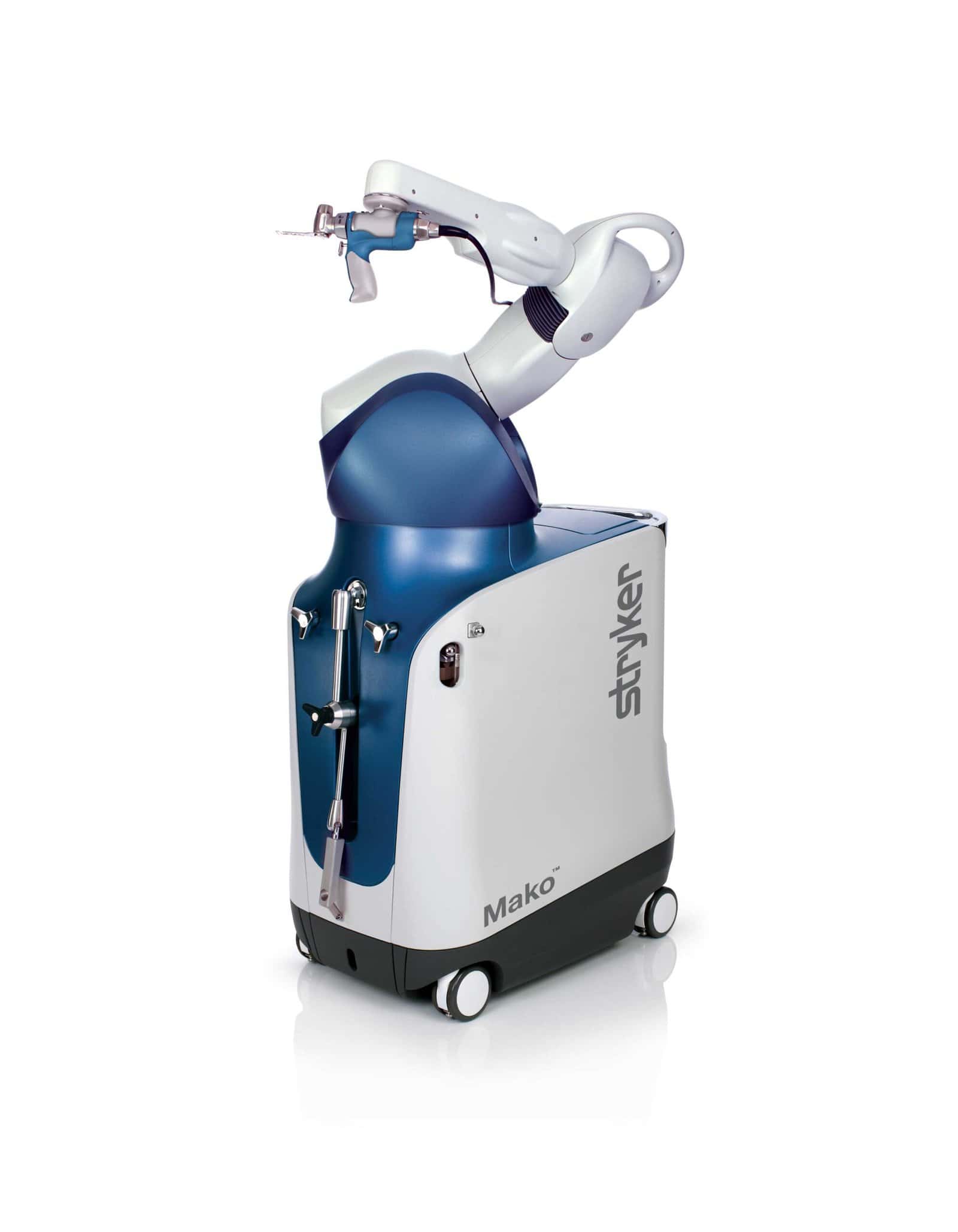
### PRESS RELEASE – SOUTHERN ILLINOIS ORTHOPEDIC CENTER BRINGS INNOVATIVE TECHNOLOGY IN TOTAL KNEE REPLACEMENT WITH STRYKER’S MAKO SMARTROBOTICS™ January 3, 2024 HERRIN, IL – Southern Illinois Orthopedic Center in partnership with the Orthopaedic Institute of Southern Illinois is the first surgery center in Southern Illinois to offer Mako SmartRobotics™. This advancement in joint replacement surgery transforms the way total knee replacements are performed. Total knee replacements in the United States are expected to increase 189% by 2030,1 yet studies have shown that approximately 20% of patients are dissatisfied after conventional surgery.2 Mako Total Knee combines Stryker’s advanced robotic technology with its clinically successful Triathlon Total Knee System, which enables surgeons to have a more predictable surgical experience with increased precision and accuracy.3 Mako SmartRobotics™ consists of three unique components – 3D CT-based planning, AccuStop™ haptic technology and insightful data analytics. In clinical studies, Mako Total Knee demonstrated the potential for patients to experience less pain, less need for opiate analgesics, less need for inpatient physical therapy, reduction in length of hospital stay, improved knee flexion and soft tissue protection in comparison to manual techniques.4, 5 “With Mako SmartRobotics™ for Total Knee Replacement, I know more about my patients than ever before, and I’m able to cut less. For some patients, this can mean less soft tissue damage; for others, greater bone preservation,”5,6 said Dr. Mike Davis, MD, surgeon and partner at SIOC and OISI. “Mako’s 3D CT allows me to create a personalized plan based on each patient’s unique anatomy all before entering the operating room. During surgery, I can validate that plan and make any necessary adjustments while guiding the robotic arm to execute that plan. It’s exciting to be able to offer this transformative technology across the joint replacement service line to perform total knee replacements.” “We are proud to be the first surgery center in Southern Illinois to offer this highly advanced robotic technology in our area,” said Dr. J.T. Davis, MD, Medical Director at Southern Illinois Orthopedic Center. “This addition to our orthopaedic service line further demonstrates our commitment to provide the community with outstanding healthcare.” For more information regarding the Mako SmartRobotics™ for Total Knee Replacement, visit Mako Robotic Total Knee Replacement or call us at 618-997-6800 to make an appointment with Dr. Mike Davis. ### IMPORTANT INFORMATION Knee Replacements Knee replacement is intended for use in individuals with joint disease resulting from degenerative, rheumatoid and post-traumatic arthritis, and for moderate deformity of the knee. Knee replacement surgery is not appropriate for patients with certain types of infections, any mental or neuromuscular disorder which would create an unacceptable risk of prosthesis instability, prosthesis fixation failure or complications in postoperative care, compromised bone stock, skeletal immaturity, severe instability of the joint, or excessive body weight. Like any surgery, joint replacement surgery has serious risks which include, but are not limited to, pain, infection, bone fracture, change in the treated leg length (hip), joint stiffness, hip joint fusion, amputation, peripheral neuropathies (nerve damage), circulatory compromise (including deep vein thrombosis (blood clots in the legs)), genitourinary disorders (including kidney failure), gastrointestinal disorders (including paralytic ileus (loss of intestinal digestive movement)), vascular disorders (including thrombus (blood clots), blood loss, or changes in blood pressure or heart rhythm), bronchopulmonary disorders (including emboli, stroke or pneumonia), heart attack, and death. Implant related risks which may lead to a revision of the implant include dislocation, loosening, fracture, nerve damage, heterotopic bone formation (abnormal bone growth in tissue), wear of the implant, metal and/or foreign body sensitivity, soft tissue imbalance, osteolysis (localized progressive bone loss), audible sounds during motion, reaction to particle debris, and reaction to metal ions (ALTR). Hip and knee implants may not provide the same feel or performance characteristics experienced with a normal healthy joint. The information presented is for educational purposes only. Speak to your doctor to decide if joint replacement surgery is appropriate for you. Individual results vary and not all patients will return to the same activity level. The lifetime of any joint replacement is limited and depends on several factors like patient weight and activity level. Your doctor will counsel you about strategies to potentially prolong the lifetime of the device, including avoiding high-impact activities, such as running, as well as maintaining a healthy weight. It is important to closely follow your doctor’s instructions regarding post-surgery activity, treatment and follow-up care. Ask your doctor if a joint replacement is right for you. References: 1. AAOS. Projected volume of primary and revision total joint replacement in the U.S. 2030 to 2060. http://aaos-annualmeeting-presskit.org/2018/research-news/sloan_ tjr/. Accessed May 9, 2018. 2. Bourne RB, Chesworth BM, Davis AM, Mahomed NN, Charron KDJ. Patient satisfaction after total knee arthroplasty: who is satisfied and who is not? Clin Orthop Relat Res. 468(1):57-63. doi:10.1007/s11999-009-1119-9. 3. Mahoney O, Kinsey T, Mont M, Hozack W, Orozco F, Chen A. Can computer generated 3D bone models improve the accuracy of total knee component placement compared to manual instrumentation? A prospective multi-center evaluation. Poster presented at: 32nd Annual Congress of the International Society for Technology in Arthroplasty (ISTA); October 2-5, 2019; Toronto, Canada. 4. Kayani B, Konan S, Tahmassebi J, Pietrzak JRT, Haddad FS. Robotic–arm assisted total knee arthroplasty is associated with improved early functional recovery and reduced time to hospital discharge compared with conventional jig-based total knee arthroplasty: A prospective cohort study. Bone Joint J. 2018;100-B(7):930-937. doi:10.1302/0301-620X.100B7.BJJ-2017-1449.R1 5. Kayani B, Konan S, Pietrzak JRT, Haddad FS. Iatrogenic bone and soft tissue trauma in robotic-arm assisted total knee arthroplasty compared with conventional jig-based total knee arthroplasty: a prospective cohort study and validation of a new classification system. J Arthroplasty. 2018;33(8):2496-2501. doi:10.1016/j. arth.2018.03.042 6. Hozack WJ. Multicentre analysis of outcomes after robotic-arm assisted total knee arthroplasty. Bone Joint J:Orthop Proc. 2018;100-B(Supp_12):38.
Take Care of Your Bones!
Can you imagine not being able to garden, travel or spend quality time with your spouse, kids or grandchildren? Without good bone health, you won’t be able to do what you love whenever you want to do it. Developing good bone health starts when you’re young and should be supported, promoted, monitored and maintained as you age. To make an appointment with the Healthy Bone Clinic and Kali Moe, NP, or our Healthy Bone Medical Director, Dr. Bob Golz, call 618-997-6800! Here are 7 reasons why you should take better care of your bones today: Bones protect important organs inside your body like your brain. Your skull is the safety helmet inside your head. The rib cage made out of bone protects your lungs and heart. Your skeletal system keeps your insides in place and adds an extra layer of protection when you need it for example, during a fall or accident. Bones form the structure of your body and make it move the way it should. It would be hard to bend over to pick up your grandchild, work in your flower bed or reel in that big one without the help of your muscles and bone working together. Healthy bones make you beautiful. Think of the phrase “good bone structure.” Your jaws and teeth are made out of bone, and they support the rest of your face and skull above it. Strong, healthy bones create strong teeth and a beautiful smile. These same bones support and prevent the fat, muscle and tissue of your cheek from sagging. You’ll look more attractive and youthful throughout your life with good bone health. Bones hold and build important nutrients and minerals that make your body work its best. Calcium is stored in the bone, and in the bone marrow, red and white blood cells are made. Red blood cells carry oxygen to your muscles and organs including your brain, liver, heart and digestive system. White blood cells fight colds, flu and other diseases. Calcium has many important roles including carrying messages between your brain and every other part of your body via nerves. Your body will use the calcium stored in your bones for this function if you don’t consume enough calcium in your diet. Your body continually makes and breaks down bone. Before the age of 30, you produce new bone faster than you break it down. After the age of 30, you lose more bone than you make it. Attaining good bone mass while you are younger will help you retain more of your bone later in life and decrease your chance of bone disease. Without good bone health, you are prone to osteoporosis. Osteoporosis is a disease that causes your bones to become weak and brittle. It is often called a “silent disease” because most people don’t know they have it until they break a bone or experience a fracture. 1 out of 2 women over the age of 50 and 1 out of 4 men will experience an osteoporatic fracture in their lifetime. One osteoporatic fracture in your spine, hip or wrist makes it more likely you’ll have another one as each fracture weakens your bones further. Taking care of injuries associated with bone loss can cause financial strain and emotional distress. When you fracture a bone, you may have to miss work to go to doctors appointments, surgery and physical therapy costing time and money. On top of that, you may have to say goodbye to dance lessons, gardening, travel plans, hunting and other activities you enjoy as your body recovers and heals. However, there is good news. It is never too late to maintain, gain or promote better bone health and prevent bone disease. Be your best advocate and ask your healthcare provider to test and monitor your bones. When you are proactive about your health, you can live life to its fullest and enjoy doing what you love most to do. Take care of your bones, and your bones will take care of you!